Work · Independent — engaged directly, not through the LLC
Agentic UX and AI workflow systems
Verizon
Sixteen interviews exposed more than forty points of friction. Ten purpose-built agents were placed at those moments, inside the tools the enterprise already allowed.
Verizon Value · 2025–present
The design decision
AI changed the workflow only after we stopped designing for AI.
- one-hour interviews
- 16+
- friction points mapped
- 40+
- purpose-built agents
- 10
- designers to wider stakeholders
- 42→80+
01 · Situation
Adoption was high. Improvement was not.
Gemini and NotebookLM were the only AI tools permitted inside a locked-down enterprise. Nine months of access had not changed how product decisions were made, while project knowledge remained scattered across people and documents.
02 · Research
Map the work before proposing the tool.
Interviews focused on the previous working day: where decisions stalled, context disappeared, and rework began. Clustering those accounts revealed more than forty opportunities that leadership could prioritise. Each friction point was scored on severity, business impact, ease of change and AI opportunity.
03 · Decision
Put each agent where its failure already lived.
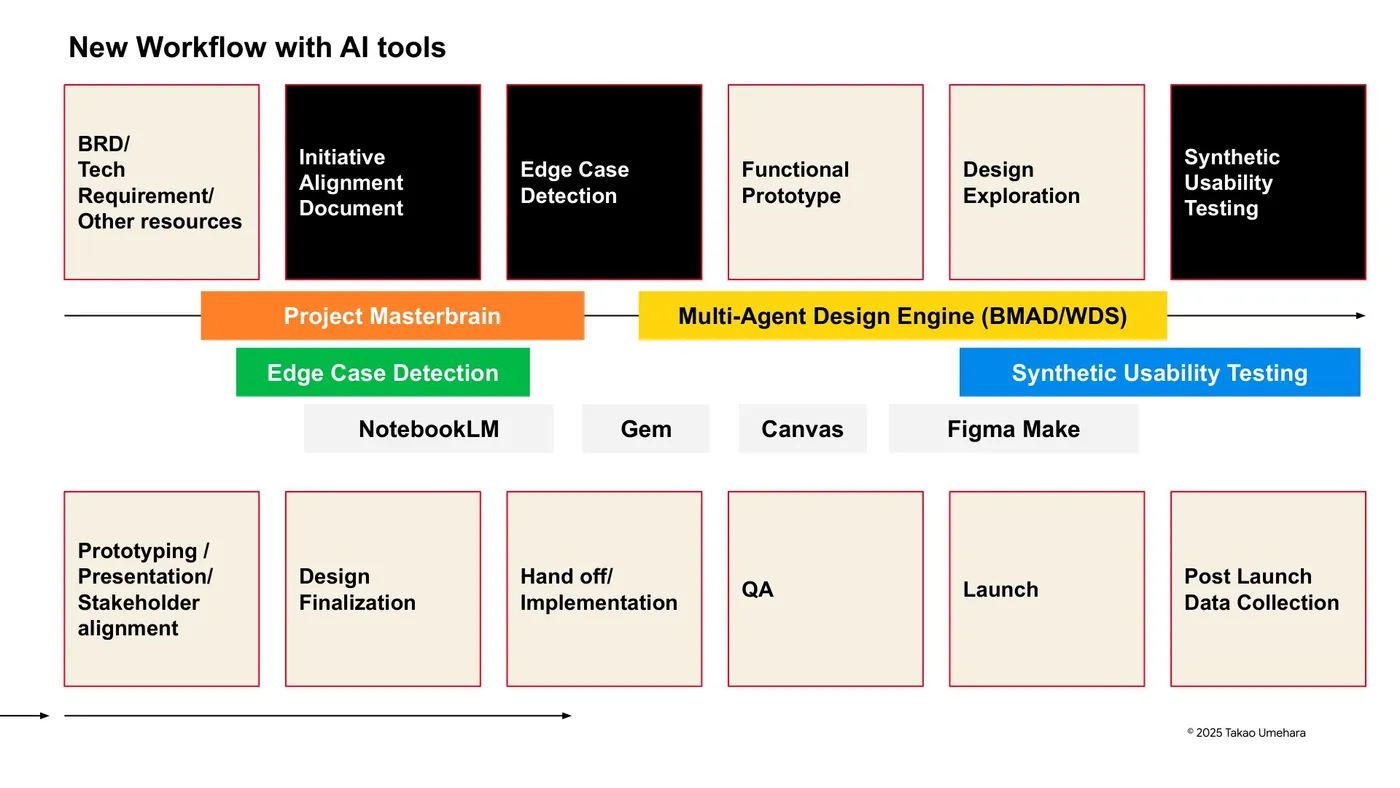
Rather than add another destination, specialised agents entered the existing workflow: project memory, edge-case detection, CX evaluation, UX writing, design support, and agent creation. The workflow gained four steps ahead of handoff: an initiative alignment document, edge-case detection, a functional prototype, and synthetic usability testing.
04 · Made
Ten agents, one operating layer.
The engagement covered agent instructions and knowledge structures, Figma connections to real design-system code, pilots, and weekly hands-on workshops for the design organisation. Each agent was built as a small filesystem — workflow, definition, knowledge — and shared as a Gem that teammates ran in their own Gemini, with no custom models and no API access.
05 · Outcome
The rollout widened beyond design.
Use expanded from 42 designers to more than 80 cross-functional stakeholders across six brands. No measured savings baseline is claimed.
- Client
- Verizon Value — six brands
- Role
- Lead Product Designer — agentic UX and AI systems
- What we made
- Ten workflow agents, project knowledge systems, prototypes, and team workshops
Credit, clearly.
Developed with Verizon designers, product managers, researchers, content specialists, strategy teams, and design leadership.
Specific internal instructions and confidential project details are generalised. No custom model was built or trained.
Bring us the part that has not resolved yet.
Tell us what you are building, what is getting in the way, and what has already been tried. We reply from New York.